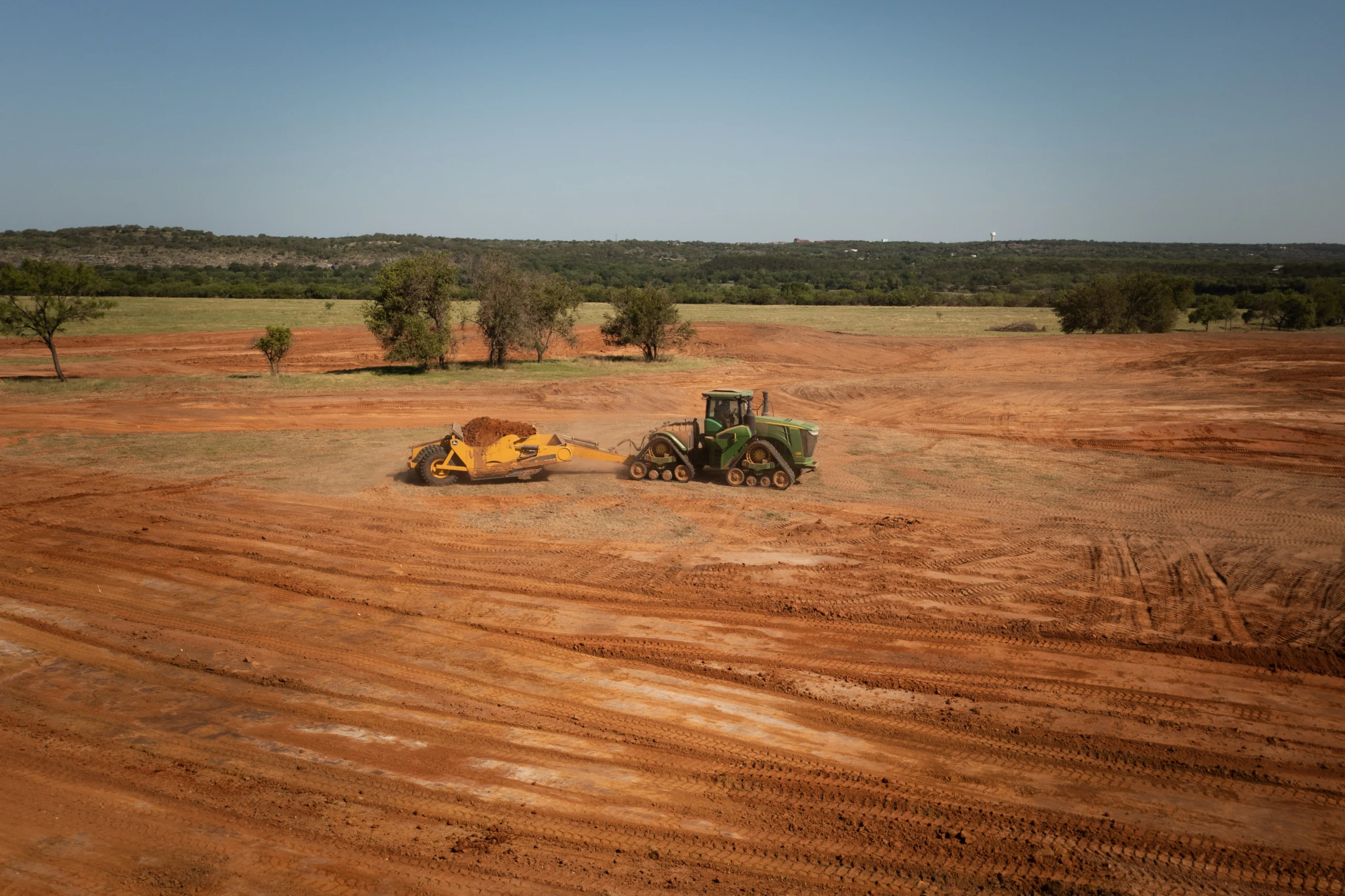
Professional land clearing in Texas can save property owners significant time and money while protecting the long-term value of their land. With professional equipment, experienced operators, and proper ranch planning, land clearing can prepare a property for roads, ponds, pastures, buildings, and other improvements without unnecessary damage to the landscape.
There’s a certain wonder to owning a piece of Texas land. For many property owners in Texas and surrounding regions, the dream is to get their hands dirty and personally shape the landscape. When faced with a bunch of trees and underbrush, the temptation to rent a skid steer and knock it out over a weekend is strong. It feels like the DIY project, a way to save money while bonding with the acreage.
However, land clearing is secretly a very complicated job. What seems like a straightforward weekend of brush removal often ends up as a multi-week ordeal of machine failures, hidden costs, and permanent damage to the land. In the world of recreational ranch development, the difference between “clearing land” and “developing land” is massive. While DIY may seem cheaper on paper, the long-term ROI of professional land clearing almost always outweighs the early savings of doing it yourself.
Industry-Leading Tech vs. Rental-Grade Equipment
The most immediate problem for the DIYer is the equipment. Most local rental yards offer basic skid steers or small tractors with normal attachments. While these are decent machines for light landscaping, they often lack the “muscle” and special guarding required for heavy, long-term removal of Texas brush.
Professional land clearing companies (like Shepco) utilize industry-leading equipment equipped with high-flow hydraulic systems and specialized mulching heads or heavy-duty grubbers. A professional-grade mulcher can turn a standing cedar tree into fine mulch in a few seconds, whereas a rental unit is likely to struggle, stall, or overheat. Furthermore, professionals use machines with low ground pressure to protect the soil structure. When a property owner spends three days doing what a professional could do in four hours, the “savings” on the rental fee are quickly evaporated by the sheer loss of time.
The Hidden Costs
When adding up the cost of a DIY project, people often only look at the rental price and the fuel. However, there are hidden costs they may not expect:
Fuel and Logistics
Large equipment burns fuel at a surprising rate. When you factor in the cost of hauling the equipment to a remote ranch, the price climbs.
Maintenance and Liability
Rental equipment is notorious for breaking down under stress, especially when used for heavy clearing. If a hydraulic hose blows or a track slips while you’re operating it, you’re probably going to have to pay for the downtime and repair costs.
Post-Clearing Remediation
DIY clearing often leaves the ground in a state of “scarring.” If a tractor is used to push trees over, it frequently brings up massive root balls and lots of topsoil, leaving behind holes and a mess that requires further grading and seeding.
A professional turnkey service wraps all these variables into a single, predictable investment. You’re paying for the machines, the insurance, the maintenance, and the knowledge that the job will be finished without extra trips to the rental yard—and that it will be done right.
The Technicalities of “Clean” Land Clearing
Land clearing for the sake of looks is one thing; clearing for infrastructure, such as roads, barn pads, or pond sites, is another. This is where professional knowledge becomes financial insurance.
As any experienced developer knows, the most expensive mistake you can make is building on a poor foundation. If a DIYer clears a site for a future shop or pond but leaves behind stumps, leaves, or root systems buried in the soil, that build is certain to fail. As that organic matter rots, the ground will shift and settle, leading to cracked foundations or leaking ponds. That’s one example of a common DIYer mistake.
Professionals clear down to the lower and denser soil layers, making sure that every square inch of the project site is structurally sound. This “clean ground” standard prevents thousands of dollars in future repair costs. Hiring an expert buys you the peace of mind that your builds are constructed on a foundation that will last for generations.
Environmental Stewardship and Wildlife Impact
In regions like the South Texas Plains or the Texas Prairies, the ecosystem is a fragile balance. Inexperienced clearing often takes an all-or-nothing approach, leaving behind a stripped, bare landscape that is going to erode and have no character.
Professional land clearers see the property through a lens of ranch planning. They understand the “edge effect” (the transition zone between cleared pastures and dense cover) that’s needed for wildlife. An expert knows when to thin underbrush for the growth of native grasses while keeping the mature trees that give a property its value and soul. This strategic clearing increases the property’s sale value and its use for hunting or recreation, whereas a poorly executed DIY clear-cut can actually decrease real estate value by removing the things that make Texas land desirable.
Safety and Risk Management
It can be easy to undersell the danger of heavy machinery and falling timber. Clearing land involves managing tension, weight, and difficult terrain. It could be a tree limb kicking back, or it could be a machine tipping over. Either way, the risks are very real for an inexperienced operator.
Hiring a professional team shifts that danger away from the landowner. Professionals are trained in site safety and have the needed liability insurance. In the event of an accident, the property owner will be protected. When you factor in the possible medical costs or property damage of a DIY accident, the professional way becomes the clear choice for risk-free landowners.
Time Is the Main Asset
Perhaps the best reason to choose professional clearing is to save time. A ranch should be a place where memories are made; a modern pastime where you spend your weekends fishing, hunting, or enjoying the sunset.
Every weekend spent struggling with a rental machine is a weekend taken away from the enjoyment of your property. By partnering with a design-build firm that handles the project management from start to finish, you go from a months-long headache to an easy process. You get to step onto a property that’s ready for whatever happens next, whether that’s a new home, a trophy lake, or a beautiful pasture.
In the end, professional land clearing is an investment in the lifespan, safety, and beauty of your Texas legacy. While the DIY spirit is a classic trait of a landowner, knowing when to call in the experts is the trait of a wise one.
From professional clearing to turnkey ranch planning, our team has the equipment and experience to do the job right.
Contact us today to start building your legacy.
Contains information related to marketing campaigns of the user. These are shared with Google AdWords / Google Ads when the Google Ads and Google Analytics accounts are linked together.
90 days
__utma
ID used to identify users and sessions
2 years after last activity
__utmt
Used to monitor number of Google Analytics server requests
10 minutes
__utmb
Used to distinguish new sessions and visits. This cookie is set when the GA.js javascript library is loaded and there is no existing __utmb cookie. The cookie is updated every time data is sent to the Google Analytics server.
30 minutes after last activity
__utmc
Used only with old Urchin versions of Google Analytics and not with GA.js. Was used to distinguish between new sessions and visits at the end of a session.
End of session (browser)
__utmz
Contains information about the traffic source or campaign that directed user to the website. The cookie is set when the GA.js javascript is loaded and updated when data is sent to the Google Anaytics server
6 months after last activity
__utmv
Contains custom information set by the web developer via the _setCustomVar method in Google Analytics. This cookie is updated every time new data is sent to the Google Analytics server.
2 years after last activity
__utmx
Used to determine whether a user is included in an A / B or Multivariate test.
18 months
_ga
ID used to identify users
2 years
_gali
Used by Google Analytics to determine which links on a page are being clicked
30 seconds
_ga_
ID used to identify users
2 years
_gid
ID used to identify users for 24 hours after last activity
24 hours
_gat
Used to monitor number of Google Analytics server requests when using Google Tag Manager
1 minute
Marketing cookies are used to follow visitors to websites. The intention is to show ads that are relevant and engaging to the individual user.
Name
Description
Duration
_gcl_au
3 months
You can find more information in our Cookie Policy and .